

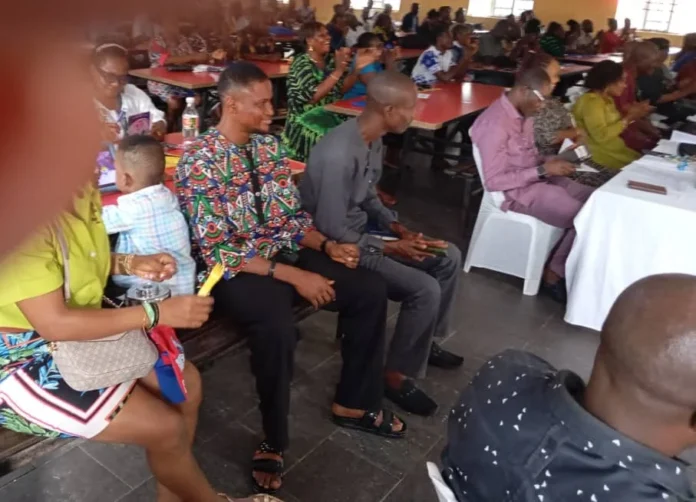
No fewer than 100 teachers drawn from public primary and secondary schools across Bayelsa State have commenced a three-day intensive training programme aimed at strengthening their capacity to teach reading, structured phonics and literacy.
The training, holding at Saint Jude’s Girls Secondary School, Amarata, Yenagoa, is being organised by the Bayelsa State Education Development Trust Fund (EDTF) in partnership with Bridge Academy International and the Teachers Training, Registration and Certification Board (TTRCB).
The programme, themed “Building Strong Readers,” has 70 primary school teachers and 30 secondary school teachers participating.
Declaring the workshop open, the Bayelsa State Commissioner for Education, Dr. Gentle Emelah, represented by the Permanent Secretary in the ministry, Mr. Simon-Peter Okene, commended the EDTF for organising the programme.
He urged participants to maximise the opportunity by applying the knowledge acquired to improve reading and literacy among pupils and students in their schools.
Also speaking, Chairman of the Bayelsa State House of Assembly Committee on Education, Dr. Charles Daniel, underscored the importance of building a strong foundation in the English language, stressing that continuous capacity building for teachers remains essential to improving classroom instruction.
The Executive Secretary of the Bayelsa State Education Development Trust Fund, Prof. Ebimieowei Etebu, said the initiative was informed by the alarming rate of poor literacy among Nigerian children.
Quoting recent figures released by the Minister of Education, Dr. Tunji Alausa, Etebu noted that three out of every four Nigerian children are unable to read and understand age-appropriate texts by the age of 10.
“Let me start with a number that should trouble all of us: the Honourable Minister of Education, Dr. Tunji Alausa, recently disclosed that three out of every four Nigerian children cannot read and understand a simple age-appropriate text by the age of 10.
“Three out of four children in our classrooms, representing 75 percent, cannot read and write. This statistic is not coming from a distant country or a different decade, but from states across this country,” he said.
According to him, reading is not a skill children naturally acquire through exposure alone, but one that must be deliberately and systematically taught.
“Reading is not acquired through exposure alone, as speech is; it must be taught explicitly and systematically—the sounds of our language, the letters that represent them, and sufficient guided practice to carry a child from decoding into fluency,” Etebu added.
Founder and Executive Director of Bridge Academy International, Mrs. Mabel Joel, who also served as the lead facilitator, said the training was designed to equip teachers with practical, evidence-based strategies to help children become confident readers.
“In the next three days, we’re not simply attending another workshop; we’re coming together around one purpose, ensuring that every child has the opportunity to become a confident reader.
“Every child in Bayelsa deserves the joy of opening a book and understanding what is on the page. Every child deserves the chance to dream beyond their circumstances, and reading is the foundation that makes those dreams possible.
“As teachers, you carry an extraordinary responsibility. The lessons you teach today will shape opportunities for pupils who may not recognise how they acquired them for years to come.
“A child who learns to read gains far more than an academic skill; they gain confidence, independence, communication and access to a lifetime of learning,” she said.
Drawing from her experience in the United States, Joel said schools that adopt evidence-based literacy instruction record significant improvements in learning outcomes.
She explained that the approach not only improves pupils’ reading ability but also equips teachers with practical classroom tools while helping schools achieve better academic results through intentional and research-driven instruction.
“The exciting part of this is that the same principles can work here in Bayelsa. Our children are capable; our teachers are committed. When we combine that commitment with effective instructional practices, remarkable things become possible.
“This training is designed to be practical. We will learn together, ask questions, practice new strategies, reflect on our learning, and leave with approaches that can immediately be applied in our classrooms,” Joel said.
Earlier, Chairman of the EDTF Sub-Committee on Development Partners, Dr. Alice Atuwo, said the training was aimed at strengthening teachers’ capacity to effectively deliver structured phonics and literacy instruction, ultimately improving reading outcomes among pupils and students across the state.


