

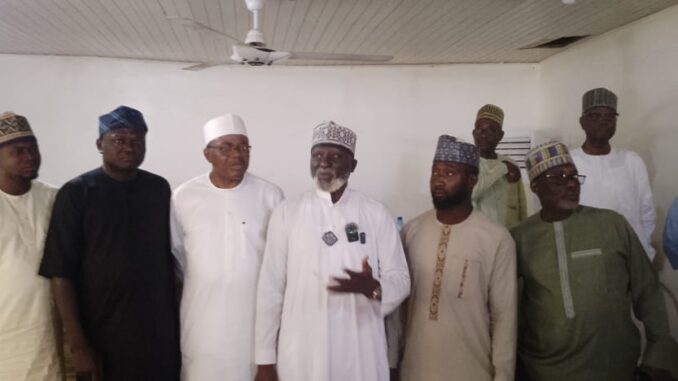
It is hard not to feel the heat that followed the birth of the Niger Rescue Movement, NRM. In states like Kebbi, Kaduna, Kano, Bauchi and Gombe, opposition voices already have weight and rhythm. In Niger, the political air had felt unusually quiet, almost sealed around Governor Mohammed Umaru Bago’s perceived dominance.
So when a splinter group walked out of the APC and named itself the “rescue,” it was bound to stir high emotions, fear, and a flicker of hope.
This reflection is not a hatchet job. It is an attempt to read the moment beyond its face value, because the moment we assess politics only through loyalty or anger, we miss the mechanics underneath.
As political scientist Giovanni Sartori warned decades ago, factions are not just about personalities. They are about access to power, patronage, and the rules of inclusion. When those rules feel broken, people do not just complain. They regroup.
The immediate trigger is already public record. According to a Daily Trust report by Nda Alhaji on Mon, 20 Jul 2026, the outcome of the APC primaries ahead of the 2027 general elections, coupled with lingering grievances, worsened the party’s internal crisis in Niger State.
Insiders told Daily Trust that the alleged imposition of candidates by Governor Bago deepened discontent and triggered exits, with many party faithful arguing that the process failed fairness, consultation, and internal democracy. Out of that fracture came the NRM, led by Mikail Bmitosahi, former Chief of Staff to ex-Governor Abubakar Sani Bello, and populated largely by Bello’s loyalists.
At its unveiling, Bmitosahi announced the “NRM Political Family” had joined the African Democratic Congress, ADC, and would begin mobilisation across all 25 LGAs, campaigning on security, jobs, education, health, water and roads. Among those named are former Commissioners Yusuf Suleiman, Usman Tinau and Mamman Musa.
The first question that sits uncomfortably is: why this particular set of faces? Abubakar Sani Bello is not Niger’s first governor, yet the core of the rescue chorus comes from his immediate administration.
Political science gives us a lens here. Samuel Huntington’s theory of elite circulation suggests that when an outgoing leader fails to anoint a successor from within his circle, the displaced elite experience what he called “status inconsistency.” They retain influence, networks and memory of power, but lose the formal levers. That gap produces urgency, sometimes moral language, often a claim to “rescue.” It is less about ideology and more about a sudden loss of patronage channels that had been taken for granted.
The same logic echoes in the defections of former councillors from Bida, Lavun and Mokwa, and in the open grievances of aspirants like Senator Mohammed Bima and Shehu Samaila Auna, who challenged the primaries in petitions and even in court. Sociologist Max Weber would call this a shift from traditional authority to rational-legal claims, even if the motive is also deeply personal.
There is also geography. Most of those named in the NRM cluster around Zones B and C. Yet the ADC has already produced its flag bearer, Dr. Mohd Kpautagi from Zone A. Here the literature on zoning and rotational power becomes unavoidable. Research on Nigeria’s federal character arrangements shows that voters and elites often accept zoning not because they love it, but because it reduces uncertainty. When a movement appears to undercut an emerging zonal rotation, it risks being read as self-interest rather than public interest, no matter how noble the manifesto sounds.
The irony is sharp: a “rescue” that could hand the biggest prize to another zone may struggle to resonate locally.
And timing matters. We are about six months to 2027, primaries are done, structures are set. The classic window for realignment in electoral studies is 12 to 18 months before polling day. After that, late entrants face what V.O. Key Jr. described as the “cost of entry problem”: voters have already formed attachments, party machinery is already oiled, and messaging competes with fatigue. The NRM says it will take its campaign to every ward, village and polling unit. That is ambitious, but ambition without time and resources often produces noise without conversion.
None of this erases the legitimacy of frustration. Primary grievances are real, and the feeling of being sidelined can corrode any party. Political scientists from Robert Michels to Nancy Bermeo have shown that internal democracy failures are the single biggest predictor of party splits in dominant-party systems. But legitimacy of grievance does not automatically translate into viability of remedy.
So we return to the title. Too little, too late? The “little” is in the narrow base of a movement drawn mainly from one former administration and two zones, stepping into a party whose presidential and National Assembly elections will hold the same day as the governorship race. Voters will face a ballot with competing loyalties, and clarity will be scarce. The “late” is in the calendar. With ADC’s candidate already emerging from Zone A and the election timetable locked, the space to renegotiate the political map has shrunk.
That does not mean the NRM will vanish. Movements born in anger often survive as pressure groups, as conscience, or as bargaining chips. But if the goal is to unseat an incumbent, then strategy must beat sentiment. And strategy, as the data and the scholars remind us, needs time, broad coalition, and alignment with the rules people already believe in, including zoning.


