

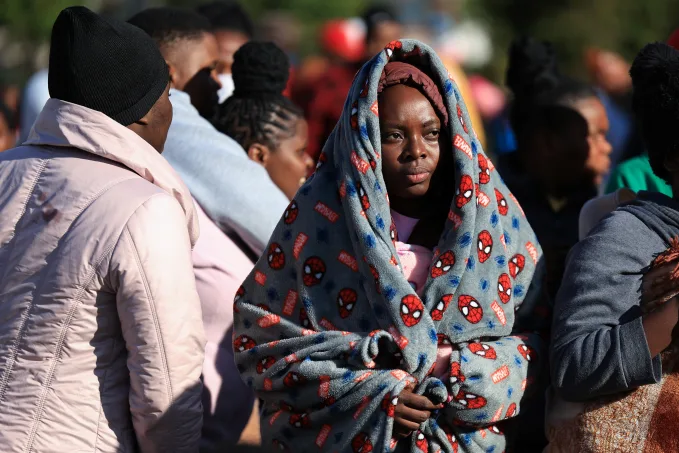
Foreigners in South Africa are fleeing the country in growing numbers as anti-migrant groups press a June 30th, 2026, deadline for them to leave, a development that has drawn condemnation from MTN Group Chairman Mcebisi Jonas.
Jonas, a former Deputy Minister of South Africa, made the remarks while delivering a tribute at the funeral of Zimbabwean-born activist Thokozani Damasane. He said the country’s anti-foreigner sentiment is not caused by migrants but rather a symptom of failures within the South African state.
“The problem is the failure of the state. The state doesn’t manage immigration. It doesn’t manage its borders. It doesn’t enforce law enforcement. It doesn’t manage education. What are you expecting?” Jonas told mourners.
He argued that deporting foreign nationals would not resolve South Africa’s underlying problems. “Foreigners can leave tomorrow, and inequality will be with us. Foreigners will leave tomorrow, and unemployment will be with us. Foreigners will leave tomorrow, and our police will remain corrupt. Foreigners will leave tomorrow, and our politicians will still be concerned with one thing: being elected and re-elected,” he said.
Jonas said politicians take advantage of public frustration to direct blame at migrants instead of addressing the country’s challenges. “When people feel the burn, they become vulnerable to politicians whose sole purpose is to be elected and re-elected. Some of them have no credibility whatsoever. But they lead marches and tell our people that the problem is not us – it is foreigners,” he said.
The crisis has been building for months, led by groups including March & March and Operation Dudula, a name that translates loosely as “push back” in Zulu. The groups have called for the “immediate and massive deportation of all illegal foreigners” and set June 30 as a deadline for undocumented migrants to leave the country.
Nkosikhona Ndabandaba, known as “Phakel’umthakathi” and a leading figure in the campaign, has more than 1.7 million followers on Facebook. He told CNN he was the architect of the deadline and warned, “June 30 is the deadline, but you don’t have to wait until then – leave now,” adding that after that date, “I can’t control the people of South Africa.”
According to South Africa’s Border Management Authority, more than 13,000 foreign nationals have been deported or voluntarily repatriated in the past two weeks. The figure includes about 9,000 Malawians, 3,000 Zimbabweans, 900 Ghanaians, and 300 Nigerians.
Police are investigating several killings linked to the unrest. Two Mozambican men were killed in late May in Mossel Bay, a coastal town in the Western Cape, where more than 50 shacks in an informal settlement were burned. Mozambique’s government said five of its citizens died in what it described as xenophobic attacks.
In Pietermaritzburg, near Durban, a Malawian man was killed by a mob at an informal settlement. The attack forced hundreds of migrants to take shelter in churches and mosques, according to state broadcaster SABC.
South African President Cyril Ramaphosa has rejected the deadline set by the protest groups and warned against any disruption. “We will not tolerate any attempts to destabilize the country by anyone, whether marching or otherwise,” he said.
Ramaphosa said attacks on foreign nationals do not show the position of the South African government or its people. He blamed the violence on “opportunists who are exploiting the legitimate grievances, particularly those of the poor, under the false guise of ‘community activism.'”
He acknowledged that illegal immigration places a strain on public services and said it “distorts the labor market” by allowing some employers to exploit cheaper labor. He, however, cautioned against blaming migrants for the country’s economic difficulties.
South Africa is home to more than 3 million immigrants, about 5% of its population, most of whom arrived from neighboring Southern African countries in search of work, according to the national statistics agency. The country’s unemployment rate stood at 32% in the first quarter of 2026, following the loss of 350,000 jobs, with young people most affected.
South Africa has experienced repeated waves of xenophobic violence since the end of apartheid, including attacks in 2008 that killed at least 62 people, and further outbreaks in 2015 and 2019.


