It has been six years since Muhammadu Buhari as Nigeria’s president was cajoled into elevating June 12 to the level of Nigeria’s Democracy Day. Before then, it was a mere pastime for pretenders to the throne of democracy to regurgitate jaded sweet nothings about June 12. They would tell you that it was a day like no other. That it was the day Nigeria actually attained the status of a democratic country. Until then, Nigeria was just a quasi-military arrangement.
And so, in order to continue to pretend that they cherish democratic ideals, they got Buhari to sign into law the Public Holiday Act Amendment Bill. With that presidential action, June 12 became officially recognized as Democracy Day in Nigeria.
In the buildup to the 2019 presidential elections, some pretenders to the throne of democracy, mostly from the south west, had cornered Buhari into recognizing June 12 as Nigeria’s Democracy Day as against the May 29 date that the country had been celebrating since 1999. The request for change from May 29 to June 12 was a political gimmick. Those behind it impressed it upon Buhari that the south west would fully embrace his second term bid if he offered them that gesture. It was a bait. Buhari fell for it. Then, on June 6, 2018, he officially announced the change. The amendment bill of 2019 placed an official stamp on the date.
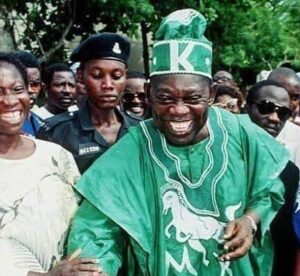
This year’s celebration of June 12 took place last week, and as usual, it was an opportunity for Nigerian leaders, especially those in politics, to pontificate. Any time they do, they sound like patriots. Unfortunately, their precepts are usually at variance with what we know about them. Such public displays are mere shibboleths within the Nigerian political establishment. Even the whole idea of June 12 has become a shibboleth. It has become no more than a ritual. When it took place in 1993, Chief MKO Abiola, who was only pronounced winner of the famed election in 2014 by Prof. Humphrey Nwosu, had a lot of sympathizers. Even though Nwosu, then chairman of National Electoral Commission, was ordered by the military establishment not to go ahead with the announcement of results, it was public knowledge that Abiola was ahead of Bashir Uthman Tofa, his challenger in that election. For this reason, those who queued behind Abiola were believed to be fighting a good cause.
But Abiola died in the process. And the military which had been in the saddle for 16 uninterrupted years yielded place to civilians. But the return of civil rule in 1999 has only helped to expose the underbelly of some of those who pretended so much about democracy, using June 12 as their shield. Since 1998 when politicians were allowed to gather again for purposes of election, the story has been one of disappointments. Civilians have proved to be worse than the military they were insistent on retiring to the barracks. Politicians are guilty of all manner of political malfeasance, be it imposition, rigging, manipulation, falsification, vote buying, electoral robbery, violence, and the like. With civilians, election in Nigeria has acquired a bad name.
But politicians and civil society organizations in Nigeria will never stop the annual ritual of June 12 celebration because Nigerians are not properly engaged. A good number of the citizenry are always looking for opportunities to ventilate their bottled up feelings of dissatisfaction. The botched election of June 12 provides them something to talk about. But the worry here is that all that lead to nowhere. They do not change anything. As a matter of fact, there was no reason to move from May 29 to June 12. Yet, Buhari fell for the gimmick because they wanted to spite former President Olusegun Obasanjo who they say benefited from the fallout of June 12. They succeeded. But what are we into now? Democracy in Nigeria has been messed up by the very people that made so much noise about it in the past.
The president political order led by Bola Tinubu is the antithesis of everything democracy stands for. But those who rolled out the drums on June 12 did not tell us this. They overlooked the point. There will be reason to romanticize June 12 if it had eventuated in a decent and enduring democratic order. The annulment did not change the way we play politics. It did not inculcate in the Nigerian politician a decent political behaviour. Since 1993, we have been hearing that that year’s election was the freest and fairest in the history of electioneering in Nigeria. For me, that is sheer idealization. The election was so packaged because it was inconclusive. If it was not annulled, stories of manipulation and rigging here and there would have arisen. Someone would have gone to court to challenge the outcome. But Nigeria was saved those distractions because the election was botched.
Even if we strongly feel that it was the best election ever in the political history of Nigeria, how have we been able to promote the ideals that marked that election out? There is nothing to point to. Rather, we are today witnessing the worst assault on democracy in Nigeria. Under the Tinubu order, the democratic space has been shrunk to the extent that one-party arrangement has become the order of the day. The opposition has been degraded to the point of irrelevance. Bad governance has snuffed life out of the people. The people have been rendered thoughtless and hopeless by hunger and hardship. For such Nigerians, all the platitudes and good talks about democracy mean nothing. They cannot connect with it.
But since some people have taken it upon themselves to make June 12 a day for political gatherings and associated matters, there is need for them to go beyond the symbolism of the day. When next they gather to talk about June 12, they should first put the present Nigerian condition on the front burner. They should dig into our democratic journey from 1999 and convince the world that real progress has been made. If we do not find reasons to thump our chests, then those who celebrate annually on June 12 should redirect their energies on how to make democracy to work in Nigeria. One of the ways of doing this is to speak truth to power. How many of the pretenders that filed out on June 12 were bold enough to tell the Nigerian story as it is? Did anyone take time out to assess what democracy looks like under the Tinubu order? If we do not confront our present dispassionately, it will not make sense to romanticize the past. Right now, those who have chosen to idealize June 12 are talking about it in a vacuum. They should talk about it in comparative terms. When they do, the established benchmarks will guide us in our future democratic journey.
QUOTE:
“Those who have chosen to idealize June 12 are talking about it in a vacuum. They should talk about it in comparative terms. When they do, the established benchmarks will guide us in our future democratic journey.”