

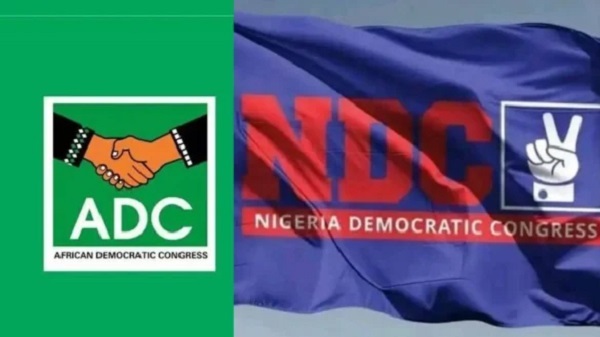
The 2013 merger that gave birth to the All Progressives Congress was not built on convenience. It was anchored on trust and resilience between political heavyweights who agreed to put Nigeria first. Late President Muhammadu Buhari and now President Bola Ahmed Tinubu, GCFR, led that process by subduing personal ambition and forging a platform that eventually rescued Nigeria from 16 years of PDP rule in 2015. The lesson was simple: coalitions work when they are rooted in shared ideology, sacrifice, and a clear rescue mission. The question now is whether the ADC and Nigerian Democratic Congress arrangements meet that standard.
The current political realignment tells a different story. Peter Obi is now a member of the Nigerian Democratic Congress alongside Rabiu Musa Kwankwaso, after both left the ADC together. On the other side, Atiku Abubakar and former Senate President Senator David Mark are leading the ADC. If the 2013 APC merger was about building something new, this looks like reshuffling old faces. The public is left wondering what changed in ideology, policy, or commitment to Nigerians between 2023 and now.
It becomes more curious when you listen to the list of public figures now gravitating toward the ADC. Mallam Nasir El-Rufai, who played a central role in forming the APC and served as governor for eight years, is now one of its fiercest critics. Aminu Waziri Tambuwal, former Sokoto governor and PDP leader, is also in the mix. Many others whose names have echoed in the corridors of power since 1999 are suddenly presenting themselves as the opposition’s new hope. Nigerians have a right to ask: what new ideas are they bringing that they couldn’t implement while in power less than four years ago?
A look at the 2023 elections provides context. President Bola Ahmed Tinubu, GCFR, won with a coalition of votes across the North and South, despite facing a divided field. More importantly, his political history shows consistency. In 2007, when Atiku Abubakar was sidelined in the PDP, Tinubu stood wholeheartedly with him under the Action Congress of Nigeria platform. In 2015 and 2019, he stood with Buhari through two terms, absorbing political risks and managing the merger’s complexities. That record of loyalty and bridge-building is why many argue that if anyone deserves a second term to consolidate reforms, it is President Tinubu.
The contrast with current coalition talk is stark. Real coalitions of ideas work because they are built on policy, not personalities. Germany’s grand coalitions between the CDU and SPD have kept the country stable through economic and migration challenges. South Africa’s Government of National Unity, after 2024, was formed around a concrete reform program. Kenya’s 2002 NARC coalition succeeded because it rallied around anti-corruption and constitutional reform, not just the removal of an incumbent. In each case, the parties subordinated ambition to a defined national agenda.
What we see in Nigeria today looks more like a coalition of power-grabbing. The ADC and NDC blocs are yet to present a policy document that goes beyond criticizing the Tinubu administration. There is no clear plan on security, inflation, power, or education that differs from what these same actors tried and failed to deliver when they held office. The conversation remains about who gets the ticket, who controls structures, and who gets compensated for defection.
The timing also exposes the opportunism. Tinubu’s administration is still early in its mandate, and the major issues Nigerians care about are security and the economy. Despite the challenges, work is in progress. If there is measurable progress in the next 10 months, the coalition’s momentum will weaken. Nigerians remember that many of the figures now preaching “rescue” were in government recently, and their track record is public record.
Right-thinking Nigerians will not be swayed by propaganda from political elites who only left power a few years ago. The 2013 APC merger worked because it was a coalition of sacrifice to rescue Nigeria. The ADC and NDC today must answer a simple question: is this about Nigeria’s future, or about recycling the same faces for another turn at the table? Until that is answered with more than slogans, the public will see it for what it is a con game dressed as a coalition.
The political elites must be careful not to overheat the polity by blaming every failure on President Bola Ahmed Tinubu alone. Nigeria runs a federal system with clear hierarchies of governance. From the Presidency down to governors and local government chairmen, responsibility for service delivery is shared. When schools lack teachers, roads collapse, or healthcare remains weak, the blame cannot stop at Aso Rock. Citizens are watching to see whether the opposition is genuinely interested in governance or simply engaged in the politics of deflection.
Since the removal of the fuel subsidy regime, state governments have received significantly increased funding and allocations. The Federation Account Allocation Committee figures show a consistent rise in monthly disbursements to states and local governments, giving subnational leaders more fiscal space than they have had in over a decade. This was deliberate, to empower governors to cushion the impact of reforms, invest in infrastructure, agriculture, and social protection. If those resources are not translating into visible improvements in communities, the conversation should shift to accountability at the state and LGA levels, not endless vilification of the federal government.
On his part, President Tinubu has recorded measurable gains across security, economy, and agriculture. In security, coordinated operations have degraded several bandit and terrorist networks in the North West and North Central, and there has been a gradual reopening of farming routes that were abandoned for years. Economically, the removal of multiple exchange rate windows and subsidy payments has stabilized public finances and improved investor confidence, with foreign portfolio inflows responding positively in 2025 and early 2026. The administration’s push on tax reforms and non-oil revenue has also expanded the fiscal base without overburdening ordinary Nigerians.
In agriculture, the government’s focus on dry-season farming, fertilizer distribution, and mechanization support has begun to ease pressure on food supply chains. The return of farmers to fields in parts of the North East and North West, areas once cut off by insecurity, is a direct result of improved security operations and targeted agricultural interventions. These are not outcomes that can be achieved by the Presidency alone, but they show that when federal policy is aligned with subnational execution, results follow. Opposition leaders should channel their energy into offering superior alternatives and holding their own governors to account, rather than stoking division by pinning every challenge on one President Tinubu.
The opposition’s inability to organize itself is becoming clearer by the day, yet the default response is to blame every internal crisis on President Bola Ahmed Tinubu. This pattern ignores both Nigeria’s constitutional structure and recent political history. The PDP’s internal rift, including the public fallout between Nyesom Wike and other party leaders, predates Tinubu’s presidency and stems directly from the party’s failure to honor its own zoning agreement ahead of the 2023 elections. That breach led to the G5 governors’ revolt and the fragmentation of the PDP’s vote. Holding the President responsible for a conflict that began inside the PDP conference rooms in 2022 ignores the documented timeline and the party’s own communiqué and convention disputes.
This narrative is also a disservice to the reality of how Tinubu himself handled opposition politics. Few Nigerian politicians have demonstrated as much respect for, and investment in, opposition building as he has. As governor of Lagos, he kept the Action Congress alive when the PDP controlled the center. In 2007, he backed Atiku Abubakar under the ACN platform against his own party’s candidate. In 2013, he subordinated personal ambition and merged the ACN with Buhari’s CPC and other parties to form the APC, providing the organizational backbone, funding, and strategy that removed an incumbent government in 2015. That coalition worked because it was built on negotiation, sacrifice, and a shared program, not on scapegoating. To claim that the same man now fears or sabotages opposition ignores his record of constructing opposition bridges and networks that eventually made his 2023 presidency possible.
This habit of blaming the President for everything only shifts attention away from where accountability truly lies. Nigeria’s governance structure runs from the Presidency through state governors down to local government chairmen, and each tier carries responsibility for delivering results to the people. With more resources now reaching states and LGAs, the real question is how these leaders are deploying them to improve security, education, and healthcare in their domains. When the ADC, NDC, PDP, LP, and NNPP reduce every internal crisis or governance gap to “Tinubu’s fault,” it makes for noisy headlines but avoids the harder question Nigerians are asking: what specific plan and discipline do these parties offer that they failed to deliver when their own leaders were in charge?
With today’s pronouncement zoning the NDC presidential ticket to the South, the desperation driving the OK Movement is impossible to ignore. After months of selling themselves as a “new force,” the bloc has resorted to geography and backroom arithmetic instead of policy and credibility. This is not coalition building. It is a scramble to lock down a ticket before Nigerians start asking the hard questions about track record and delivery. When the strategy is “anyone but Tinubu” with no superior plan on security, inflation, or power, the game is clear.
If Atiku Abubakar or Rotimi Amaechi emerges on the ADC platform, the choice for voters becomes even easier. These are figures who have been at the center of power since 1999, with records Nigerians can measure directly. Contrast that with President Bola Ahmed Tinubu, GCFR, who built opposition platforms, backed northern leaders when it was politically costly, and has spent the last three years making tough calls on subsidy removal, exchange rate unification, and revenue reform. The difference is between a history of sacrifice and delivery, and a recycling of the same elite network under new acronyms.
The ADC-NDC arrangement is not an alternative to President Tinubu, it is a con game for power. Nigerians remember who was in office less than four years ago and what was delivered. With zoning gimmicks replacing policy and leadership, the coalition’s momentum will fade once voters weigh records against promises. In the next few months, 2027 will be a referendum on results, not on recycled ambitions.
Danaudi, Public Affairs Analyst Writes From Bauchi Via danaudicomrade@gmail.com


