

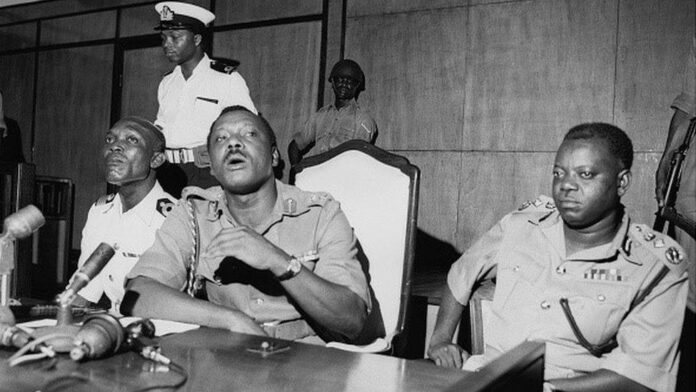
The coup of January 15 1966 is older than me by a good ten and a half years. But very few events in Nigeria’s history have enthralled me like that drama. For over two decades and counting, I have made the study of the coup, the circumstances that led to it, and its aftermath an obsession. Once I catch a whiff of the latest article on Exercise Damisa, I am after it like a starving dog sighting meat. A book, a report, a picture, I am off like a high-velocity bullet. At times, I get this weird feeling that Chukwuma Nzeogwu, Emmanuel Ifeajuna, and Adewale Ademoyega were my homeboys in my neighbourhood. Outside articles, I have tried my hand on fiction based on some of the dramatis personae of the coup. One of such short fiction ended up as a script for a short film about Emmanuel Ifeajuna shortly before his execution for alleged treason against Biafra. The movie, titled ‘The Encounter’, was released in 2015.
Over the years, with the scrutiny of records about the coup and what was said and unsaid in them; perusal of the at times white-hot polemics of fellow Nigerians and even foreigners on the coup; and at times reflection on the human angles of that putsch, I have had cause to develop some personal insights. You need not agree with them. But a journey with those the great British scholar S.E. Finer refers to in his classic ‘Man on Horseback’ as ‘empirical autocracies and oligarchies’ convinces me such insights are worth bringing to the public domain. Against the background of venom laced with ethnic bigotry, ignorance, politics, and at times outright falsehood usually served as standard fare by Nigerians when they talk about the first coup, I hope my insights have some elements of maturity.
First, no matter how anyone paints it, the coup of January 1966 was unadulterated high state treason. What the young officers did that blood-soaked Saturday violated the basic principles of military code. You do not turn the guns meant to protect the state on the state. The coup plotters who wrote accounts of their action have a different view: they were messiahs out to rescue a drowning Nigeria. But at least Major Emmanuel Ifeajuna, the ‘brain’ of the coup, was honest enough to admit in his unpublished account about the plot that: ‘we(the plotters) fully realized that to be caught planning, let alone acting, on our lines was high treason. And the penalty for high treason is death.’
That leads to a sobering thought: was the situation in Nigeria, barely six years free from colonial rule, so bad to justify such a conscious decision by Ifeajuna and Company? This short essay is not the forum to examine the complex combo of developments in Nigeria within that period. For beginners who want to understand the times and circumstances in which the plotters struck, I recommend Max Siollun’s book ‘Oil, Politics and Violence’ as a take-off manual. But the fundamental facts of those times are in public domain: the 1962 Action Group crisis that led to Nigeria’s first post-independence declaration of a state of emergency in the Western Region; the 1963 census madness; the 1960 and 1964 Tivland bloodbath; the charade of the 1964 general elections, and the violence that accompanied the 1965 Western Region elections. Could these events have been avoided? Or handled differently? Would such a course of action take the wind out of the sails of the plotters? We can only speculate.
In his book ‘The Seven Pillars of Wisdom’ the English soldier and adventurer, Thomas Edward Lawrence, popularly known as Lawrence of Arabia, wrote:
‘All men dream: but not equally. Those who dream by night in the dusty recesses of their minds wake in the day to find that it was vanity: but the dreamers of the day are dangerous men for they may act their dream with open eyes, to make it possible.’
These nuggets, so beloved of military and revolutionary treatises as well as popular culture media since Lawrence wrote them, clearly motivated the young men who swung an axe at the centre of Nigeria’s first democracy. I cannot say for sure if Nzeogwu (a widely read soldier from available contemporary accounts), or Ifeajuna and Ademoyega (both university graduates who moved in top notch intellectual and radical circles of their time) were beholden to Lawrence’s books and ideas. But their accounts show that they dreamt with their eyes wide open. They envisioned a new Nigeria. In Ademoyega’s words: ‘we had no need to doubt we would accomplish our task. Thus we began to prepare for the great day that would mark the beginning of a definite effort to awaken the country from her slumber.’ (Ademoyega. ‘Why We Struck’ p.66).
Very idealistic. The plotters probably saw themselves in the garb of Egypt’s Colonel Abdel Nasser’s Free Officers Movement. But that is the danger of idealism that refuses to recognize cold and ugly facts. A coup in a country like Nigeria, even back then already torn along ethnic, religious and political lines, would not be welcomed as a revolution, no matter how honourable its plotters’ intentions. Indeed, Nzeogwu, Ifeajuna and company were men in a hurry. Nzeogwu’s commander, Brigadier Samuel Ademulegun, once described the coup leader as ‘a young man in a hurry who should be watched closely.’ The ‘January Boys’ were so wide-eye opened to their dream of a new Nigeria that they became blind to the fact that Nigeria was (and is still) not a nation waiting to be born. Nigeria is still an expression bereft of definition.
Many intellectuals, readers and thinkers have over the years sifted fact from fabrication about the January coup and its plotters. But ugly perceptions simply refuse to die. These perceptions rather than the facts still determine how many Nigerians see the coup sixty years after the shots were fired, and their countrymen who share some affinity with the plotters. Unfortunately certain information about the coup remains suppressed till date though almost all the major actors and supporting cast in the play have exited life’s stage.
For instance, where is the full and authentic copy of the report of the Special Investigative Panel that interrogated the plotters after their arrest and detention? Only snippets have been sighted on platforms till date. And in my opinion, the great Chinua Achebe did humanity a great disservice by not publishing Emmanuel Ifeajuna’s account of the coup when he brought it to the author’s publishing house in Enugu shortly after the civil war began. Yes, there were flaws in the account as Achebe noted. Yes, Ifeajuna might have been exaggerating things. And the fact that Nzeogwu called Ifeajuna’s account lies carries a lot of weight. But with the loss of both men and their accounts, we are poorer for it with vast lacuna being filled in by fabrications. And the Nigerian state’s attitude to the coup and Ifeajuna does not give any hope that the manuscript will see light of day soon, at least in Nigeria.
Whose interests are being served by continued playing of the ethnic card about the coup? Superficially, it is very easy to swing the coup on an Igbo pivot. Most of its leaders were Igbo or Igbo-speaking. Most of its casualties were non-Igbo; top Igbo politicians were unhurt; Enugu, the capital of the old Eastern Region, was spared the hail of bullets that rained on Kaduna and Ibadan. General Ironsi who took over the reins of power, whether he knew about the coup or not, was Igbo. And he did not subject the plotters to a firing-squad.
But a momentous event in a country’s life, like the first coup in Nigeria’s evolution, should not be cast in black and white. All its shades of gray should be brought to the fore. They should take full public space, even in the face of calumny. Just like the venom that was unleashed on former president Ibrahim Babangida, a full-blooded Northern Nigerian, for writing that Nzeogwu and his colleagues did not strike from ethnic considerations in his autobiography ‘A Journey in Service.’ But Nigeria cannot heal or have some form of closure from that night of Exercise Damisa ( Nzeogwu’s code name for the coup) or Operation New Wash ( Ifeajuna’s code name) until we accept all sides to the story must be told by all who have valid information to be put out in the public domain. This does not excuse or justify the tragedies these officers caused. What it means is that by recognizing all aspects of the narrative, including those we may be averse to individually or as a group, Nigerians will no longer be hostages to a tragic history. Sixty years is enough time to start the process of liberation.
Henry Chukwuemeka Onyema is a historian, author and teacher. His unpublished novel was longlisted for the 2024 Quramo Writer’s Prize.
Email: mazihenry007@gmail.com


