

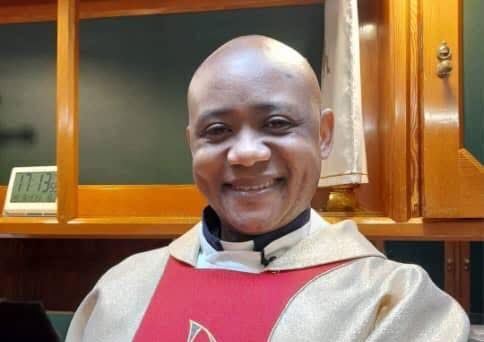
Shikrot Mpwi – Sunday Synopsis
Fr. Justine John DYIKUK
Dear friends in Christ,
On the Feast of the Baptism of the Lord, Year A (11 January 2026), I bring you greetings and God’s blessings!
Theme: Our Consecration in Christ
Introduction
Friends in Christ, the Baptism of the Lord brings Christmastide (the Christmas Season) to an end. Baptism is a Sacrament. Simply put, “a sacrament is an outward sign of inward grace ordained by Christ.” Sacraments are carried into three: Sacraments of Christian initiation (Baptism, Holy Eucharist, and Confirmation), Sacraments of Christian healing (Anointing of the Sick and Penance) and Sacraments of Christian Communion (Holy Orders and Holy Matrimony).
Baptism washes away original sin, makes of children of God and members of the Church. Infants are baptised to free them from original sin, grant them salvation, appropriate grace (Cf. CCC 1250), catch them young for Christ, and connect with parents’ faith. Baptism by water (sprinkling or immersion), baptism by blood (martyrdom) and baptism by desire (those who wished to be baptised but died before receiving the Sacrament).
Accordingly, the RICE acronym, which helps us understand the sacrament better, stands for: R – Rebirth (through water and the Holy Spirit); I – Initiation (full membership into the Christian community); C – Consecration (to spread the gospel) and E – Empowerment (by the Spirit to overcome evil) (Kasomo, 2016).
In the first reading, Isaiah suggests that the messiah would establish true justice and peace. In the second reading, St. Peter assures that the Lord loves anyone from any nationality who fears God. The gospel relates Jesus’ baptism and his endorsement as the beloved son.
Review of the Readings
The first reading (Isaiah 42:1-4, 6-7) suggests that the messiah would establish true justice, become a light of the nations, open the eyes of the blind, and free captives from prison, including those living in darkness.
In the second reading (Acts 10:34-38), St. Peter assures that the Lord does not have favourites but loves anyone from any nationality who fears God and does what is acceptable to him. He contends that it was Jesus who brought the Good News of peace after he had been baptised in the Jordan by John and endowed with the Holy Spirit, went about doing good and curing all who had fallen into the power of the devil.
The Gospel (Mat. 3:13-17) reveals that Jesus came to the Jordan to be baptised by John and to fulfil righteousness. Just then, heaven opened and the Holy Spirit descended on him in the form of a dove. The voice of the Father spoke: “This is my beloved Son, with shown I am well pleased.”
Pastoral Lessons
1. With escalating conflicts around the world, the first reading urges world leaders to prioritise respecting human dignity through concerted efforts to establish justice and peace.
2. Isaiah’s message invites us to be deliberate about making preferential treatment for the poor by caring for the lonely, unloved and those at the margins of society.
3. Just as St. Peter testified that Jesus went about doing good, Christians are challenged to use the Church’s ministry of hospitality to care for the sick and those who have fallen into the power of the devil.
4. Jesus’ humility invites us to remove our sandals of pride to step into the holy grounds of God’s glory.
5. In a society where Christians seem increasingly lured by earthly pleasures, we are urged to pray that the fire of the Holy Spirit may come down to renew the face of the earth.
Conclusion
Like your birthday, always remember and celebrate the day you were baptised. It is heart-warming that we all share in “the Common Priesthood of Christ” through baptism. Ministers of the Word and Sacraments, who share in the “Ministerial Priesthood of Christ,” are urged to be diligent dispensers of grace. We are called to activate the “Passive Effects” – what we receive from God and the people of God – rebirth, initiation, consecration, and empowerment as well as the “Active Effects” – what we give to God and the people of God – our commitment and dedication to a cause, to spread the kingdom of God, in our lives (Kasomo, 2016). May the cleansing power of the Holy Spirit help us to keep our baptismal promises. Amen. Have a fabulous week ahead!


