

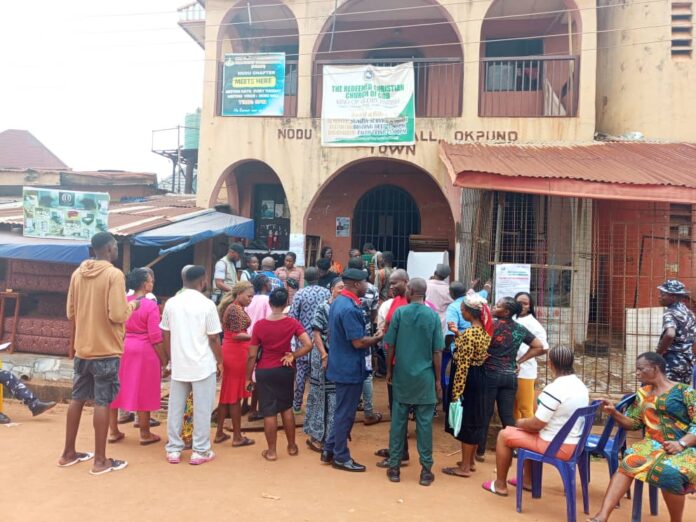
A non-governmental organisation and accredited observers for the Anambra Governorship Election, TAF Africa has called for intensified efforts towards ensuring full participation of Persons With Disabilities (PWDs) in Nigeria’s election process.
In a press statement signed by the Senior Communications Officer, Lynn Agwuncha and made available to journalists in Awka, the organization tasked the Independent National Electoral Commission (INEC) and other stakeholders to take decisive steps to address persistent gaps in accessibility and inclusion, noted during the Anambra Governorship Election.
TAF Africa with support from the European Union Support to Democratic Governance in Nigeria EU-SDGN II, Programme, had deployed 150 trained citizen observers, 25 sign language interpreters, and roving media monitors across the 21 local government areas of Anambra State and coordinated through the TAF Disability Hub Application, a real-time, data-driven platform for tracking accessibility, assistive tools, and the voting experiences of PWDs.
The initiative, according to the group, was part of its commitment to promoting inclusive democratic participation and evaluating how far electoral stakeholders uphold the rights of PWDs under the Discrimination Against Persons with Disabilities (Prohibition) Act, 2018.
TAF Africa noted that the presence of SLIs significantly improved communication between deaf voters and election officials, allowing many to cast their votes independently.
The organization urged INEC to institutionalize this practice in future elections to ensure that deaf voters are not excluded from the process.
The group’s field report, however, identified several shortcomings in the provision of assistive materials.
“Despite INEC’s indication that magnifying glasses would be available for voters with albinism at polling units in Awka South LGA, observers found that both magnifying glasses and braille ballot guides were missing, making it difficult for visually impaired voters to vote independently.
“However, the availability of assistive devices was low at 32%, even though 89.4% of polling units were physically accessible to PWDs as priority voting was granted in 74.8% of cases, and 35.2% of polling stations had PWDs serving as INEC ad hoc staff.
“Encouragingly, 68.3% of voters displayed positive attitudes toward PWDs, though 5.8% of registered PWD voters could not vote due to accessibility barriers or procedural lapses.
“TAF Africa also observed instances of voter manipulation involving PWDs, including Nise Ward I, where a deaf voter was reportedly approached by a suspected party agent who attempted to influence his choice of candidate.
“Similar incidents were recorded involving visually impaired voters who received unsolicited assistance from individuals believed to be partisan agents,” it said.
The statement noted that vote buying was also reported in several locations, like Idemili North local government area, where party agents were seen offering ₦1,000 to voters, including PWDs, while in Ogbaru LGA, a female agent allegedly distributed ₦5,000 to voters on behalf of a political party.
TAF Africa condemned the exploitation of PWDs in such activities, noting that it undermines their dignity and the integrity of the electoral process.
The group, however, noted that despite these issues, the election was largely peaceful, with 99.3% of observed polling units reporting calm and orderly voting.
The organization also urged INEC to, regularly update disability-disaggregated voter data to ensure accurate deployment of assistive materials; improve logistics for distributing magnifying glasses, braille guides, and other tools; provide mandatory disability inclusion training for all ad hoc staff; and, enforce sanctions for non-compliance with inclusion protocols.


