

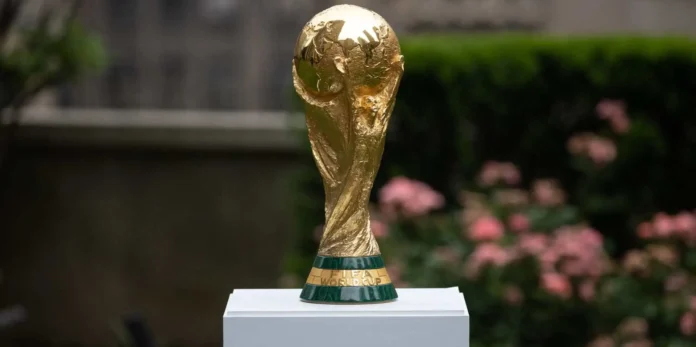
Football fans across the world will remember the 2026 FIFA World Cup as the last tournament to feature two of the game’s greatest icons, Lionel Messi and Cristiano Ronaldo. However, beyond the excitement on the pitch, the competition co-hosted by the United States, Mexico and Canada was marked by a series of controversies that dominated global headlines.
One of the earliest issues centred on access to the host countries, particularly the United States and Canada.
On June 6, Somali referee Omar Artan was denied entry into the United States and barred from officiating at the World Cup after U.S. Customs officials at Miami International Airport cited security and vetting concerns.
A few days later, Ghanaian midfielder Thomas Partey missed his country’s opening match against Panama in Toronto after Canadian immigration authorities denied his visa application. Officials cited his ongoing criminal proceedings in the United Kingdom involving multiple charges of rape and sexual assault.
The Iran national team also faced strict travel restrictions imposed by U.S. authorities, who required the players to enter the United States no earlier than 24 hours before each match and leave immediately after the final whistle. As a result, the team was based in Tijuana, Mexico, throughout the tournament.
The visa restrictions drew criticism from football fans across the world, many of whom argued that football should unite people rather than become entangled in political disputes.
Former England international Ian Wright described the situation as chaotic.
“This is the World Cup of Chaos. Tickets are exorbitant, travel costs are high, and visas are being rejected. Is this how a host behaves?” he said.
Many supporters also believed FIFA and the host nations could have done more to ease visa processes for fans and tourists travelling to the tournament.
A Nigerian football enthusiast, James Ogunjimi, argued that countries with restrictive entry policies should reconsider hosting global sporting events.
“The U.S. and Canada shouldn’t host any FIFA tournament again. Leave international tournaments alone so that people banned don’t try to enter your country to come and play football,” he said.
Responding to criticism after referee Artan was denied entry, a FIFA spokesperson said on June 9 that the organisation does not interfere in immigration decisions made by host governments.
“FIFA is not involved in host country immigration processes, including visa adjudications. In line with previous FIFA events, a host government ultimately determines who receives a visa and who is admitted into their country,” the spokesperson said.
That was not the only FIFA decision to spark widespread debate.
The football governing body came under intense scrutiny after announcing that the red card issued to U.S. striker Folarin Balogun during the Round of 32 match against Bosnia and Herzegovina on July 1 had been suspended for a one-year probationary period, allowing him to feature in the Round of 16 clash against Belgium.
While speaking with reporters at the White House, President Donald Trump confirmed that he had spoken with FIFA, urging the organisation to allow Balogun to play.
Reacting to the decision, European football governing body UEFA described it as “incomprehensible and unjustifiable.”
Another issue that generated intense reactions was FIFA’s implementation of the mouth-covering prohibition, a rule championed by FIFA President Gianni Infantino.
The regulation followed an incident in February 2026 during a UEFA Champions League match in which Real Madrid’s Vinicius Jr. accused Benfica’s Gianluca Prestianni of racial abuse. Because Prestianni covered his mouth with his shirt while speaking, officials and television cameras were unable to determine what had been said.
The incident gave rise to what became known as the “Prestianni Law.”
During the World Cup, Paraguay’s Miguel Almirón and Ecuador’s Piero Hincapié were both sent off for violating the rule.
Although the law applies only during confrontational situations, many fans and football stakeholders criticised it as excessively harsh and vulnerable to abuse.
The controversy nearly resurfaced in the World Cup final when Spain defender Marc Cucurella briefly covered his mouth while speaking to Lionel Messi. The Argentine captain immediately protested, demanding that the Spanish defender be sent off.
UEFA has since announced that players who violate the rule in its competitions will receive a yellow card rather than a red card.
FIFA also attracted criticism after introducing mandatory three-minute hydration breaks during each half of World Cup matches, saying the measure was necessary to protect players’ health and welfare.
Under the regulation, referees stopped play in the 22nd minute of the first half and the 67th minute of the second half for water breaks.
While coaches such as Mauricio Pochettino used the stoppages to relay tactical instructions, France coach Didier Deschamps criticised the policy, arguing that it disrupted the flow and momentum of matches.
Many supporters appeared to share that view. Fans at the England versus Ghana match booed loudly when the referee halted play for the scheduled hydration break.
Some critics alleged that FIFA used the policy to create additional television advertising opportunities, with reports suggesting the governing body generated significant extra commercial revenue during the tournament.
Despite the tournament’s commercial success, the expanded 48-team format also divided opinion.
Carlos Queiroz, who coached Ghana at the tournament, argued that the World Cup had become “vulgar and ordinary” because qualification was no longer as difficult as before.
Football enthusiast Abdulaziz Opeyemi said the previous 32-team format offered a better balance between quality and exclusivity, although he acknowledged the benefits of broader global participation.
“For me, the 32-team World Cup was the perfect balance of quality and exclusivity. However, if the goal is to make football truly global, the 48-team format is a reasonable way to accommodate that,” he said.
Opeyemi, however, opposed any further expansion.
“But what I am against is expanding it to 64 teams. At that point, qualifying for the World Cup would lose its prestige, and the tournament could become too long and diluted,” he added.
The final on Sunday brought the curtain down on an entertaining tournament that produced a record 308 goals across 104 matches.
While the 2026 FIFA World Cup delivered unforgettable football and broke several records, many observers believe it also exposed organisational and officiating challenges that FIFA and future hosts will need to address before the next edition.
Source:NAN


